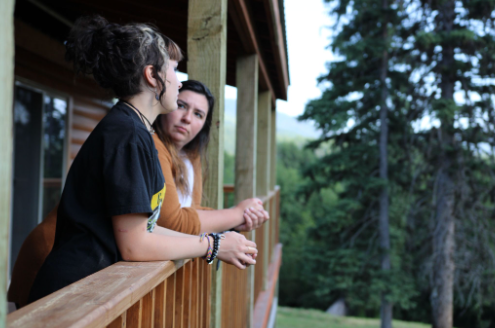
By the time most families find their way to a remote corner of northwestern Montana, they have already tried everything. The therapists, the medication adjustments, the family meetings, the long drives home in silence. Parents arrive exhausted, carrying a grief that is hard to name because their child is still alive and yet somehow unreachable.
It is exactly that kind of grief that gave birth to Turning Winds. Founded in 2002 by John Baisden Sr. and John Baisden Jr., the program grew out of personal loss, a father’s determination to spare other families the suffering his own had endured. More than two decades later, the school and residential treatment center sits on 150 acres of Montana wilderness, serving adolescents between the ages of 13 and 18 who are facing emotional, behavioral, or mental health challenges.
The program has remained family-run from the beginning, and that origin story is not just a footnote. It shapes the work every single day.
“We strive to always look at the end from the beginning,” the team explained in a recent program review. “We want to create a sustainable path of success for each client.”
A Philosophy Built Around One Question: What Does the End Look Like?
That forward-facing orientation is the thread running through everything Turning Winds does. Every clinical decision, every academic adjustment, every outdoor excursion is measured against a single outcome: does this move this specific teenager closer to lasting change?
It sounds simple. It is not. Adolescents who arrive at Turning Winds often carry years of accumulated pain, disrupted schooling, and fractured family relationships. Getting them to take one step forward, let alone sustain momentum over months, requires a flexible and responsive system of care.
That system is called the Integrated Therapeutic Curriculum, or ITC. It weaves together clinical therapy, accredited academics, and outdoor experiential education into a single unified framework rather than treating each as a separate program running alongside the others. “Our ITC is a multidisciplinary approach which blends clinical, academic and recreational experiences to promote and inspire our clients to engage and move through the treatment process,” the program’s leadership explained. The underlying logic is practical: if a teenager is not responding to progress in one discipline, the team looks to create that movement in another.
A student who shuts down in a therapy room might open up on a hiking trail. A kid who has failed every English class might find traction in a small classroom with one teacher and a pace he can actually manage. Turning Winds treats these openings as equally valid.
Where the Classroom Meets the Wilderness
The academic program at Turning Winds carries full accreditation from Cognia, one of the most recognized accrediting bodies in American education. Class sizes average around ten students per instructor, and one-on-one instruction is available for students who need it. Teenagers can accelerate through coursework at their own pace, which matters for two very different groups: students who arrive behind grade level and students who are academically advanced but emotionally struggling.
The program is designed to support both without flattening either. “Turning Winds provides the support necessary to facilitate meaningful learning regardless of whether or not we have a student on an IEP or conversely a student with an advanced educational pedigree,” the team noted. That range reflects the actual population walking through the doors.
Outside the classroom, the Montana landscape becomes the curriculum. Hiking, biking, boating, and athletic challenges are not add-ons. They are part of the treatment architecture. The absence of screens and devices is also intentional, creating space for teenagers to rebuild social awareness and genuine connection with the people physically around them. No algorithm, no scroll, no performance for an audience that is not in the room.
The program also holds Joint Commission accreditation, the gold standard for mental health treatment facilities. For families trying to evaluate options, that credential carries real weight alongside state licensing.
What the Numbers Reveal and What a Visit Reveals More
In 2024, Turning Winds completed a patient outcome assessment review. The results showed a statistically significant decrease in both anxiety and depression among students who completed the program. Approximately 98 percent of graduates go on to college or trade school.
Those are meaningful numbers. But the program’s leadership is quick to point families toward something that a data sheet cannot capture.
“Visit, visit, visit,” the team urged. “I cannot state how important that is for parents. You cannot fake good vibes and smiles among the clients at Turning Winds or any treatment center for that matter.” The advice is grounded in experience. A parent who walks the campus, meets the clinical team, and sits with the atmosphere will learn something that no brochure can communicate. The feel of a place matters. So does the character of the people running it.
Stays at Turning Winds average six to nine months, longer than many comparable programs. That length is deliberate. Genuine therapeutic progress and sustained behavior change require time that shorter programs simply cannot provide.
Families Are Part of the Treatment, Not Waiting on the Sidelines
One of the most consistent findings in adolescent mental health research is that family involvement changes outcomes. Turning Winds has built that finding into the program’s structure rather than leaving it to chance.
Parents are required to participate throughout the process. The expectations are specific:
- Weekly family therapy sessions with the clinical team
- Assigned reading and clinical homework between sessions
- Attendance at a structured parent workshop
- At least one in-person local visit where parent-child dynamics play out in real time
“If they are willing to make parenting changes and engage in a meaningful way, then it contributes immensely to the success of the child,” the team said. The visit requirement is particularly revealing. Bringing a parent into the physical environment, with all the history and tension that relationship carries, is a controlled stress test. It is also an opportunity.
Beyond the formal requirements, Turning Winds runs an ongoing parent support group moderated by both current and former parents who have been through the program themselves. That peer dimension, people who understand the specific fear and hope of this particular journey, adds something a professional facilitator alone cannot provide.
Service as Treatment: From the Yaak Valley to the Developing World
At 20-plus years of operation, Turning Winds has woven itself into the fabric of the surrounding Montana community in ways that are both practical and purposeful. Staff and students help neighbors in the Yaak area with firewood, support local events, and partner with nearby school districts on scholarships and athletics.
But the most striking service initiative reaches much further. Students have the opportunity to participate in international service learning experiences, traveling to developing countries to help teach, build educational facilities, or construct water systems for communities that lack them. “It is a rich experience of cultural immersion and servitude that impacts both the giver and recipient of such service,” the team reflected.
For teenagers who arrived at Turning Winds feeling like a burden to the people around them, that experience carries a particular kind of weight. Helping someone else is one of the more reliable ways to begin believing you are capable of it.
Turning Winds also made a mark at the state policy level. The program played a leading role in developing Montana Senate Bill 191, which creates a residential treatment center license in the state. That legislative change expands the ability of families across Montana to use their insurance benefits to access care. “Our consistent efforts in the space of improving mental health treatment in Montana has provided us the opportunity to really make some solid changes in this state,” the team said.
What Happens After a Teen Leaves the 150 Acres
The program accepts both in-network and out-of-network insurance, working with major carriers including Blue Cross Blue Shield, Optum, Cigna, Aetna, and TriCare East and West. That breadth is not incidental. If cost becomes the barrier that stops a family from getting help, the outcome of that decision follows a teenager for the rest of their life.
Alumni support extends well beyond graduation. The program runs a podcast that has given former students a platform to speak about their experiences in their own words, including one episode featuring an alumnus describing the specific ways Turning Winds shifted the course of their life. The podcast also addresses broader adolescent mental health topics for a wider audience of parents, educators, and families trying to understand what teenagers are carrying right now.
The 98 percent college and trade school placement rate is a clean headline. But the quieter stories behind that number, of teenagers who arrived unable to trust an adult and left able to ask for help, of parents who came to the campus workshop defensive and left with something cracked open, of students who built a water well in another country and finally understood what they were capable of, those are the ones that explain why a family-run program in the Montana wilderness has been doing this work for more than 20 years.
“We want to create wins for each one of our clients,” the Turning Winds team said simply. In the end, that is the whole mission, made plain.
This article is for informational purposes only and does not constitute medical advice. Families seeking mental health treatment for adolescents should consult a qualified licensed healthcare professional to determine the appropriate level of care for their specific situation.