


|
COVID-19 Cases |
||
| Shelby County Cases | 379 | |
| Deaths | 1 | |
| Total Tested in Shelby County | 4382 | |
| Tennessee Total Cases | 1537* *As of 2 p.m. 3/29/20 |
|
|
Other Jurisdictions |
||
| Tipton County, TN | 15 | |
| Desoto County, MS | 71 | |
| Crittenden County, AR | 17 | |
| Numbers current as of 10 a.m. 3/30/2020 | ||
Shelby County currently has 379 confirmed COVID-19 cases, according to Joan Carr, public information officer for the Shelby County Health Department (SCHD). That includes one death. To date, a total of 4,382 persons have been tested for the COVID-19 virus in Shelby County. Here is a breakdown of current cases by age range: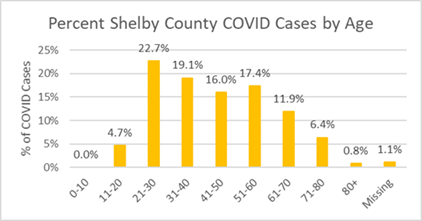
The Health Department is committed to providing as much information as possible to the public as the COVID-19 situation continues to develop. The Health Department’s hotline number (833-943-1658), was activated March 12, 2020. Since that date, it has fielded hundreds of calls from the general public about COVID-19. Below are statistics about calls into the hotline since March 12, 2020, and a daily number of hotline calls fielded yesterday.
|
Health Department Call Center Statistics |
|
| Total Calls Received since 3/12/20 | 1759 |
| Total Calls Answered 3/29/20 | 34 |
The COVID-19 hotline is answered each day, including Saturday and Sunday, from 8 a.m. to 4:30 p.m.
After-hours calls are returned as soon as possible on the next business day.
 There are indications that person-to-person spread in the workplace and the community is taking place. The Health Department recommends strict adherence to social-distancing recommendations:
Individuals and Families:
- Stay at home. It is safer to stay at home. Leave home for essential activities only, such as going to work if you are considered essential personnel, the grocery store or pharmacy.
- While Shelby County School students and many others are out of school, keep children home and plan home-based activities.
- Avoid handshakes and close contact with others whenever possible.
- Seniors and those with certain chronic health conditions are at risk for serious illness from COVID-19 infection, and must take special care to avoid exposure to the virus: https://www.cdc.gov/coronavirus/2019-ncov/specific-groups/high-risk-complications/older-adults.html.
- Surgical masks are proven to reduce the transmission of infection. Masks serve two functions. First not transmitting infection to others and, second, not becoming infected with an infection. In general, masks should be used in public by those who are ill and caregivers of persons with a respiratory illness. During a pandemic with sustained community transmission, masks should also be worn by individuals who are elderly, have multiple medical problems or have a weak immune system. At present there is no clear strong evidence for the general public to wear a mask, however, given widespread transmission of COVID-19, the general public may consider using a mask (when available) or a facial covering. All individuals should also practice hand hygiene and maintain a distance of six feet to reduce the risk of infection. Masks may serve as additional protection when combined with other preventive measures.
- Cancel or postpone gatherings of 10 or more people. Instead of visiting friends or relatives, call or video chat.
- Children and adults may exercise outdoors, while maintaining at least six feet of distance from others.
- Do not go to work or go out in public if you are sick, especially with fever, muscle aches/pains, cough or other respiratory symptoms.
- Postpone or reschedule elective health care visits/procedures
- Avoid all non-essential travel. Re-evaluate travel plans. It is strongly recommended to avoid any unnecessary travel. If traveling overseas, check the CDC’s travel advisory website, which is updated daily: https://wwwnc.cdc.gov/travel. If traveling within the U.S., avoid destinations where COVID-19 has been reported: https://www.cdc.gov/coronavirus/2019-ncov/travelers/travel-in-the-us.html
- Avoid non-essential flights. Traveling by private vehicle limits exposure to other people.
- Wash your hands thoroughly and often with soap and water for at least 20 seconds. Scrub dirt under fingernails with a brush and soap.
- Practice respiratory etiquette by using a tissue if coughing or sneezing, then throwing the tissue away and washing your hands.
- Sanitize surfaces that are frequently touched by many people with anti-bacterial wipes or diluted bleach solution, or other FDA-approved cleaning products: https://www.americanchemistry.com/Novel-Coronavirus-Fighting-Products-List.pdf.
- Take care to protect yourself and your loved ones if you are recovering from COVID-19 at home, or caring for a person with the virus: https://www.cdc.gov/coronavirus/2019-ncov/if-you-are-sick/index.html.
Community/Business Leaders:
- Individuals who are exhibiting signs and symptoms of illness, including fever, muscle aches/pains, or cough should not be in public, the workplace, or other settings.
- Cancel or postpone meetings and conferences of 10 or more people, including worship services.
- Consider conducting conferences or meetings by phone or video chat rather than face-to-face.
- Adhere to CDC travel guidelines by reviewing the CDC’s travel website (https://wwwnc.cdc.gov/travel) Avoid all nonessential travel. Avoid travel to countries and communities that are experiencing ongoing transmission.
https://www.cdc.gov/coronavirus/2019-ncov/travelers/travel-in-the-us.html.
- Discourage workers from using other workers’ phones, desks, offices, or other work tools and equipment, whenever possible.
- Encourage and enable employee telecommuting to limit person-to-person interactions as much as possible.
- Encourage social distancing by spacing out customer service and check-out lines as much as possible.
- Consider providing delivery or curbside pick-up options to limit interactions in stores.
Keeping Shelby County residents, elected officials, and faith and community leaders informed is an important part of our strategy to control the spread of COVID-19 in our community.