

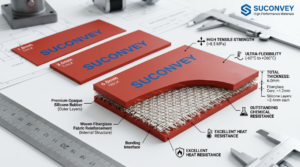
Introduction to Fiberglass Reinforced Silicone Sheet
In industries where heat, chemicals, and mechanical stress push materials to their limits, standard silicone rubber often falls short. That is where the fiberglass reinforced silicone sheet steps in — a composite material bonding silicone rubber with woven fiberglass fabric to combine the best of both components. The silicone delivers flexibility, heat resistance, and chemical inertness. The fiberglass adds dimensional stability, tensile strength, and tear resistance. Together they form a material that outperforms either component alone.
This guide covers composition, key properties, types, applications, selection criteria, and fabrication tips to help engineers, procurement specialists, and maintenance teams make informed decisions.
What is Fiberglass Reinforced Silicone Rubber Sheet?
Composition and Manufacturing
The manufacturing process laminates woven or non-woven fiberglass fabric with silicone rubber compound, then cures the assembly under heat and pressure. Uncured silicone is calendered into thin layers, applied to both sides of the fiberglass fabric to saturate the weave, and then vulcanized to permanently bond the rubber matrix to the reinforcement. The fiberglass remains fully embedded — invisible externally but structurally integral.
Multi-layer constructions using two or more fiberglass plies are available for applications requiring additional strength and thickness.
Key Properties
- Temperature resistance: Maintains physical integrity from -60°C to 260°C, without hardening at low temperatures or softening at high temperatures.
- Electrical insulation: High dielectric strength and volume resistivity, suitable for elevated-temperature electrical applications where standard polymer insulators would degrade.
- Chemical resistance: Resists water, steam, dilute acids and alkalis, oils, and ozone. Not suitable for concentrated organic solvents or strong oxidizing acids.
- Non-stick surface: Valuable in food processing and manufacturing where material adhesion to equipment surfaces is undesirable.
- Dimensional stability: Flexible enough to conform to uneven surfaces for sealing, yet stable enough to maintain consistent thickness under clamping loads.
Types of Fiber Reinforced Silicone Sheets
Reinforcement Options
Fiberglass is the most widely used reinforcement for silicone sheets, and for good reason. Polyester fiber alternatives lose strength above 150–175°C, limiting their temperature range significantly. Aramid fiber (Kevlar) offers superior puncture resistance but at much higher cost, with no thermal advantage over fiberglass. Carbon fiber produces the stiffest composites but is cost-prohibitive for most industrial applications.
For the vast majority of industrial, electrical, and food processing uses, fiberglass delivers the optimal balance of performance, workability, and cost.
Standard Specifications
A fiberglass silicone sheet is available in red, gray, or black for industrial identification purposes, with custom colors available. Red, derived from iron oxide pigments, is the most common and visually associated with high-temperature silicone products.
Standard thickness range: 1mm to 6mm, with 1.5mm, 2mm, 3mm, and 4mm being most commonly stocked.
Hardness: Shore A 50–80. Softer grades (Shore A 50–60) compress more readily for irregular surfaces; harder grades (Shore A 70–80) offer better dimensional stability under load for high-pressure gasketing.
Sheet formats: Typically 1m × 1m or 1m × 10m rolls, with custom cutting available.
Applications of Fiberglass Reinforced Rubber Sheet
Industrial Sealing and Gasketing
The fiberglass reinforced rubber sheet functions as a durable gasket in high-temperature environments where standard rubber or compressed fiber materials would harden, extrude, or chemically degrade. Key applications include:
- Industrial oven door seals requiring compression and elasticity through thousands of thermal cycles
- Heat exchanger gaskets in chemical plants handling steam and hot process fluids
- Food processing equipment — autoclaves, ovens, and processing vessels where FDA compliance and steam-cleaning resistance are mandatory
- Flanged pipe connections in high-temperature systems requiring controlled compression without extrusion
Electrical Insulation
Fiber reinforced silicone rubber delivers excellent dielectric strength, and the fiberglass reinforcement adds the mechanical integrity needed for structural insulation duties. Applications include:
- Phase-to-phase insulators and barriers in transformers and electrical switchgear
- Cable wrapping and termination insulation in elevated-temperature environments
- Circuit board and power module protection as a barrier and cushioning layer
The reinforcement prevents creep or tearing under mechanical stresses during installation, ensuring insulating barriers remain intact throughout service life.
Conveyor Belts and Heat Shields
A reinforced silicone sheet withstands constant abrasion and heat, making it standard for baking conveyor belts in commercial food production. The non-stick surface, food-safe silicone, and tensile strength from fiberglass reinforcement are all essential to this application.
Additional heat shield uses include:
- Welding curtains and blankets protecting equipment and personnel from spatter and radiated heat
- Exhaust system heat shields in automotive and industrial applications protecting nearby wiring and components
Fiberglass Reinforced Silicone vs. Fiberglass Reinforced Plastic
Key Differences
Fiberglass reinforced plastic (FRP/GRP) embeds fiberglass in a rigid polymer matrix — typically polyester or epoxy resin — producing a hard, structural panel used in boat hulls, vehicle body panels, and chemical storage tanks. It cannot be compressed or flexed without cracking and has no sealing capability.
Fiberglass reinforced silicone outperforms FRP in three critical areas:
| Property | Fiberglass Reinforced Silicone | FRP (Epoxy/Polyester) |
| Max continuous temp | 260°C+ | 120–180°C |
| Flexibility | Elastic, compressible | Rigid, cracks under flex |
| Steam resistance | Excellent | Prone to hydrolysis |
FRP retains its advantage in structural applications requiring stiffness, load-bearing capacity, and dimensional precision. For sealing, insulation, and thermal cycling, fiberglass reinforced silicone is the clear choice.
How to Choose the Right Fiberglass Reinforced Rubber Sheet
Temperature and Chemical Exposure
Start by defining the maximum continuous operating temperature. Standard silicone handles continuous service to 200°C with intermittent peaks to 220°C. High-temperature formulations extend continuous service to 250°C and above — appropriate for steam, industrial ovens, or exhaust components.
Assess all chemical exposures including cleaning agents, lubricants, and environmental factors such as ozone and UV. Cross-reference with the supplier’s chemical resistance data to confirm suitability.
For food processing, confirm FDA 21 CFR compliance or EU food contact material compliance in writing before specifying. Not all silicone sheet products meet these standards.
Thickness and Hardness
A fiber reinforced rubber sheet of 3mm thickness balances durability and conformability for most general sealing and insulation applications. Guidelines:
- 1–2mm: Greater flexibility, easier die-cutting, better compression against irregular surfaces; lower mechanical strength
- 3mm: Best general-purpose balance of conformability and durability
- 4–6mm: Higher thermal insulation, puncture resistance, and load capacity; less flexible, higher cost
Softer hardness grades suit irregular sealing surfaces; harder grades resist extrusion under high bolt loads but require flatter mating surfaces.
Installation and Maintenance Tips
Cutting and Fabrication
Use sharp tools to prevent fiberglass fraying at cut edges, which can cause delamination over time. Recommended methods by application:
- Straight cuts (up to 3mm): Sharp utility knife with fresh blade against a steel straightedge
- Thicker sheets or volume production: Guillotine cutter or fine-toothed band saw
- Complex gasket shapes: Waterjet cutting for clean, heat-free cuts with no tool wear
- Volume gasket production: Steel rule or solid steel blanking dies in a hydraulic press
When drilling, use sharp twist drill bits at moderate speed with the material supported close to the hole to prevent tearing.
Storage and Lifespan
The primary degradation risks for stored silicone sheet are UV radiation, ozone, and compression set. Store in opaque packaging away from direct sunlight, electric motors, and welding equipment. Do not stack sheets under heavy loads — store flat or in rolls for thin gauges.
When stored correctly at room temperature, fiberglass reinforced silicone sheet retains its properties for several years. In service, lifespan depends on operating temperature, chemical exposure, and mechanical cycling.
Frequently Asked Questions
Is Fiberglass Reinforced Silicone Safe for Food Contact?
Food-grade fiberglass reinforced silicone sheet is widely used in bakery conveyors, oven door seals, and steam cooking equipment. However, only materials manufactured with FDA 21 CFR compliant silicone compound qualify for food contact. Always request written compliance documentation from suppliers — industrial-grade silicone sheets may contain additives not approved for food use.
Can Fiberglass Reinforced Silicone Be Recycled?
Recycling options are limited. The bonded silicone-fiberglass composite cannot be easily separated for individual material recovery, and most municipal programs do not accept it. Some industrial silicone scrap recycling programs exist, but throughput is limited. Treat this as a long-life material and maximize service life through correct selection and installation to minimize replacement frequency.
Conclusion
The fiberglass reinforced silicone sheet earns its place in demanding applications by delivering thermal stability from -60°C to 260°C, strong electrical insulation, broad chemical resistance, and the mechanical strength that fiberglass reinforcement provides. No simpler material matches this combination.
Select the right compound for your temperature and chemical environment, choose appropriate thickness and hardness, and confirm compliance certifications where required. Request material data sheets and samples before committing to volume purchases, and consult suppliers about custom specifications for non-standard requirements. Correctly specified and maintained, this composite delivers long service intervals and low total cost of ownership.
By: Chris Bates