

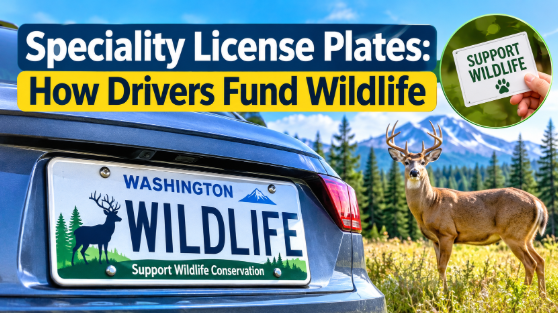
Every year at renewal, you pick your plate. And some plates send money straight to wildlife. Choose the wolf design for your Colorado license plate, for example, and $50 a year goes to Colorado Parks and Wildlife.
That adds up faster than you’d think. Colorado’s “Born to Be Wild” wolf plate surpassed $1 million in sales just 21 months after its launch. Other Western states have quietly built similar programs that fund wildlife crossings, disease labs and habitat work.
Here’s how the money moves from your bumper to the field, which plates do the most good, and how to decide if one is worth it for you.
Key Takeaways
- Only part of each plate fee goes to wildlife.
- The yearly renewal fee does most of the long-term good.
- Colorado’s wolf plate helps pay for range riders.
- Wyoming’s plate funds highway crossings for deer and pronghorn.
- Check your state DMV for current fees before you order.
How a License Plate Turns Into Conservation Money
A state law creates each of these speciality license plates. That law also decides how much you pay and who gets each dollar.
Where Your Fee Actually Goes
Most plate fees split three ways. Part covers making the plate. Part covers DMV processing. The rest goes to a wildlife agency or a nonprofit partner.
Colorado’s wolf plate is a clear example. According to Colorado Parks and Wildlife, here’s how the plate fees break down:
- $25 one-time to the highway users tax fund
- $25 one time to the Colorado DRIVES vehicle services account
- $50 every year to the wildlife cash fund at CPW
Why the Renewal Fee Matters Most
The one-time fees cover the cost of the plate itself. The yearly fee is what keeps wildlife programs running. So a driver who keeps a wolf plate for five years sends $250 to CPW. A driver who drops it after one year sends $50.
Colorado’s Wildlife Plates
Colorado offers two plates built around wildlife, and they fund very different work.
The Born to Be Wild Wolf Plate
The wolf plate shows a grey wolf against a mountain skyline under a starry night sky. It went on sale in January 2024. By the end of September 2025, 20,647 wolf plates were registered, and sales had topped $1 million.
Under state law, that money funds nonlethal tools that help wolves and ranchers share the land. One big example is the Range Rider Program. Riders patrol herds, watch for predators and haze wolves away from cattle, sometimes on night shifts. CPW says revenue from the plate helps support the program. It estimated the program would cost about $500,000 in 2025, with riders covering nine northwest Colorado counties.
CPW also sets aside $50,000 of yearly plate sales for grants that promote the plate. More plates on the road mean more money for coexistence work.
A Quick Note on Cost
High Country News reported a first-year cost of $118, while CPW’s page lists $100 in plate-specific fees. Standard plate charges likely explain the gap. Either way, confirm your total with your county motor vehicle office.
The Wildlife Sporting Plate
This one is for anglers and hunters. You pay a $50 one-time fee and a $10 first donation, then $25 a year at renewal. CPW says the money goes to fish habitat, angling access and public shooting ranges.
Where to See the Wildlife These Plates Support
The money feels more real once you’ve seen the animals yourself. Drive into Lake City CO, high in the San Juan Mountains, and you’ll see why so many Coloradans pay extra to protect wildlife. Deer wander right through town.
Here’s where to look nearby:
- Moose browse the willows on the south side of Lake San Cristobal.
- Bighorn sheep and pikas live on the rocky slopes above timberline.
- Elk herds gather north of town, mostly in winter.
- Deer Lakes is another good bet for moose.
Bring binoculars and keep your distance. Moose can charge, so stay in your car if one is near the road.
How Other States Use Plates for Wildlife
Several states have turned plates into steady wildlife funding, and each one picked a different problem to solve.
| State | Plate | What it funds | Reported results |
|---|---|---|---|
| Wyoming | Wildlife conservation plate | Highway crossings and fencing | About $930,000 raised by Nov. 2023 |
| Idaho | Elk, trout and bluebird plates | Disease lab, boating access and more | Almost $13 million since 2013 |
| Washington | Personalised and wildlife plates | Fish and wildlife programs | About $3.9 million a year from personalised plates |
| Montana | Vital Ground Foundation plate | Grizzly bear habitat | More than $1 million since 2008 |
| Florida | Protect the Panther plate | Panther research and rescue | Funds most of the state’s panther work |
These figures cover different time spans, so treat them as examples, not a ranking. The first four come from High Country News.
Wyoming Shows What the Money Can Build
Wyoming’s plate is the easiest to see in action. Its money goes to wildlife crossings. And crossings work. At Trappers Point, Wyoming Game and Fish says vehicle-wildlife crashes dropped by more than 80% after an overpass opened in 2012.
That’s a win for drivers too.
Florida Funds a Single Species
Florida’s panther plate takes a narrow approach. Its fees go to the Florida Panther Research and Management Trust Fund. The state wildlife agency says that fund has paid for almost all of its panther work for about 30 years.
Is a Wildlife Plate Worth It?
For most drivers who care about wildlife, yes. Just go in with clear eyes.
What Works
- The money is steady. It doesn’t depend on yearly budget fights.
- It pays for practical tools, like crossings and range riders.
- You support wildlife without thinking about it every year.
What to Keep in Mind
- Only part of your fee reaches wildlife. The rest covers the plate and processing.
- Renewal fees add up, so plan for them.
- Some plates touch hot topics. The wolf plate, for example, sits in the middle of a heated debate. Pick a plate you’re happy to display.
How to Get a Wildlife Plate in Your State
- Check your state DMV’s list of speciality plates.
- Read who gets the money and how much.
- Order online, or switch at your next renewal.
- Ask if you can personalise it, and what that adds.
- Keep it for years to multiply the impact.
FAQs
Do wildlife license plates really help animals?
Yes, wildlife license plates really help animals when the money reaches proven work. In Wyoming, plate money helps build crossings, and one overpass area saw crashes drop by more than 80%.
How much of my plate fee goes to wildlife?
How much of your plate fee goes to wildlife depends on the state and plate. On Colorado’s wolf plate, $50 of each year’s fee goes to CPW. Check your state DMV for the exact split.
Can I switch to a wildlife plate before my renewal date?
In many states, you can switch to a wildlife plate before your renewal date, but rules vary. Ask your county motor vehicle office or state DMV before you order.