

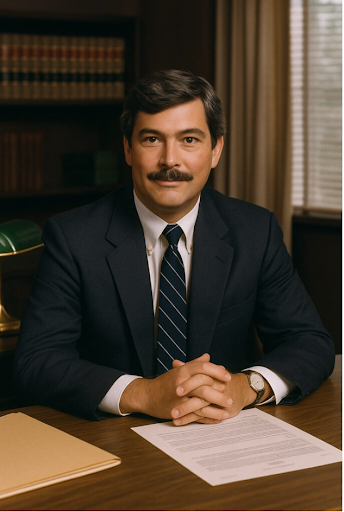
 Jim Bain stood in front of a courtroom in 1980, a young attorney fresh from the Tennessee Valley Authority’s legal department, tasked with recovering hundreds of millions for his client in one of the most complex antitrust cases the energy sector had seen. The Uranium Antitrust Litigation would eventually yield $250 million from Gulf Oil. Not bad for someone only a few years out of law school.
“Success is defined by the impact you have on others, not just the milestones you achieve,” Bain says, though those milestones keep stacking up anyway.
Jim Bain graduated cum laude from the University of Connecticut in 1972 as a member of Phi Beta Kappa. Four years later, he earned his law degree from the University of Florida, again cum laude. [He initially became a member of the Tennessee Bar, which was a first for TVA’s attorneys, because it required briefing the issue in Tennessee.] What followed was a career that would take him from teaching law students trial practice to building one of Denver’s most respected law firms.
He didn’t start in Colorado, though. After law school, Bain accepted a position with the 90-attorney staff at the Tennessee Valley Authority’s legal department. That kind of early responsibility shapes a lawyer. Sink or swim. Bain swam.
By 1985, he’d made his way west to Colorado, joining Roath and Brega and partnership came within a year. In 1990, he became a partner at Brega and Winters, and by 2004, he’d helped found Benjamin Bain and Howard. The firm added Al Cohen in 2009, becoming Benjamin, Bain, Howard and Cohen.
Four Decades of Legal Evolution in Colorado
Bain’s arrival in Colorado in 1985 came during a period of growth for the state. Denver was expanding. The construction industry was booming. Legal frameworks that worked for a smaller, more rural Colorado needed updating.
His work on builder-vendor liability helped push that evolution. “Each defining moment in your career adds a new chapter to your story,” he says.
The move from TVA to Colorado was one of those moments. So was the decision to help found a boutique firm rather than stay with a larger practice. Each choice shaped what came next.
“Your career is a tapestry woven with threads of experience, passion, and vision,” Bain has noted.
His tapestry includes that early uranium litigation victory, the transition to Colorado, the building of a respected boutique firm, the years of teaching and writing and service to the profession. Not a straight line, a career rarely is, but a coherent arc from that young TVA attorney in 1980 [I became a member of the Tennessee bar in 1977.]to a recognized name in Colorado construction and commercial real estate law.
The Phi Beta Kappa membership from his undergraduate days suggested intellectual horsepower. The cum laude law degree confirmed it. The career that followed proved he could apply that intellect to real-world problems in ways that served clients, advanced the law, and educated other lawyers.
Building a Practice in Jim Bain’s Style
Construction law became Bain’s specialty, but it was never just about contracts and disputes. It was about understanding how things get built, who takes the risk when a project goes sideways, what happens when a homeowner discovers defects years after closing, the intersection of property rights, commerce, and Colorado’s growing legal space.
“When you pursue a career fueled by passion, every challenge becomes an opportunity,” he says.
His 1987 articles on builder-vendor liability came at a pivotal moment in Colorado law. Bain’s work mapped the terrain for other lawyers, explaining not just what the law was, but where it was headed. Defenses, damages, the practical implications for builders and buyers alike. [These seminal articles led to a plethora of other firms bringing innumerable lawsuits against builders and developers, substantially changing the Colorado legal landscape.]
Public construction presented its own maze of regulations and potential pitfalls. His 1988 piece in the Colorado Lawyer laid out those challenges. By the time he published “Landmark Changes in Colorado Construction Law” in 1997, he’d spent more than a decade watching the field evolve. He’d helped shape some of those changes through his cases, his writing, and his teaching. The article captured a decade of transformation in how Colorado approached construction disputes.
“Professional identity is built on a foundation of personal values and unwavering integrity,” Bain says.
That integrity showed up in his role with the Associated General Contractors. For five years as chairman of the legal advisory committee, Jim Bain Colorado bridged the gap between the industry and the law. Contractors aren’t lawyers, but they need to understand the legal framework that governs their work, so Bain translated.
The Teaching Track Alongside Jim Bain’s Law Practice
Most lawyers pick a lane: practice or academia. Bain drove both.
His teaching covered trial practice and appellate advocacy, the core skills every litigator needs. Trial practice isn’t something you learn from a textbook; it’s about standing up, making arguments, reading a jury, knowing when to push and when to let the other side hang themselves with their own rope. Appellate advocacy is different, cleaner, and more intellectual. Convincing judges through written briefs and oral arguments that the trial court got it wrong.
Students at the University of Florida and the University of Colorado got both from Bain, along with other courses that pulled from his decades of practice. Not theory, application.
“To grow professionally, one must remain a lifelong learner, curious and adaptable,” he notes, which is easier said than practiced while running a law firm.
The editing work for the Construction Forum added another dimension. For more than 20 years, he reviewed submissions, shaped content, and kept Colorado lawyers informed about developments in construction law. That’s a long tenure for what amounts to unpaid service to the profession but it kept him connected to emerging issues and younger lawyers entering the field.
His seminar work followed a similar pattern. The Colorado Bar Association, the American Bar Association, and specialized real estate sections. When you serve as Seminar Chairman for the Institute for Advanced Legal Study, you’re not just showing up to present; you’re organizing, curating, and making sure the content serves the audience.
“Professional values are the compass that guides you through the complexities of professional life,” he says.
Those values apparently included service. You don’t edit a bar publication for 20 years if you’re just chasing billable hours. You don’t chair committees or teach law school or present seminars unless you think the profession matters beyond your own practice.
Jim Bain Gains Recognition Beyond the Colorado Courtroom
Awards are tricky. Some mean something, others are pay-to-play vanity projects.
The Civil Litigation Writing Award from the Colorado Bar Association in 1986-87 came from his peers, lawyers who read his work and recognized its quality. That matters and so does the Super Lawyer designation, which uses a research-driven selection process rather than self-nomination.
Marquis directories carry weight in certain circles. Who’s Who in American Law, Who’s Who in America, Who’s Who in the World. The kind of recognition that signals a career of substance. Outstanding Lawyers of America limits inclusion to 100 per state, creating at least some scarcity in the selection.
“Achievements are the milestones that reflect the dedication to your craft,” Bain says.
His craft involved more than winning cases, though the Gulf Oil recovery alone would be enough for most careers. It included shaping how other lawyers approached construction disputes through his writing. Serving on arbitration panels where his experience helped resolve conflicts without the cost and delay of litigation.
The National Panel of Arbitrators for the American Arbitration Association draws from experienced practitioners who understand both the law and the business context of disputes. Construction arbitrations can be particularly complex, involving multiple parties, technical issues, and contracts that run hundreds of pages. Commercial cases bring their own challenges. Jim Bain Colorado handled both.
“Real success lies in lifting others as you climb towards your goals,” he says. This sounds like a platitude until you look at the teaching, the mentoring, the committee work, and the editing.
When Newsweek profiled Benjamin Bain, Howard and Cohen, the firm had become something specific in the Denver market. Not a giant firm trying to be everything to everyone. A boutique practice focused on commercial real estate, staffed by lawyers who’d earned individual recognition for their work. Four partners, all Super Lawyers. That’s rare.
The profile captured a firm that had found its niche and dominated it. Commercial real estate in Colorado involves everything from development deals to financing to disputes over property rights. The firm Bain helped build became the go-to option for clients who needed that expertise.
“The foundation of a meaningful career is built on integrity and dedication,” Bain has said.
Foundation’s solid. The structure built on it has held up through market changes, legal evolution, and the shift from that courtroom in 1980 to now. That’s the thing about careers. They’re not planned as much as they’re built, one decision at a time. Bain’s decisions led him to become a fixture in Colorado law, a teacher, a writer, a builder of a firm that outlasted most. The milestones matter, sure, but he’s right about the impact on others being the real measure.