
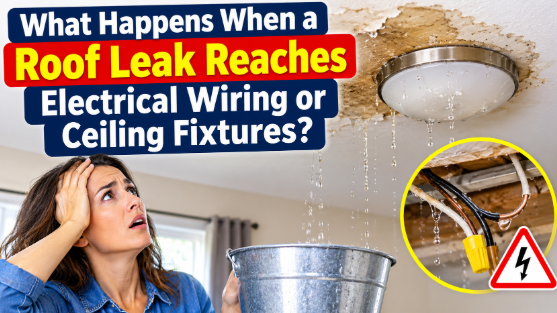
The first sign may be a water droplet hanging from a recessed light rather than a stain on the ceiling. A storm has been underway for hours, and the fixture begins to flicker. The homeowner reaches toward the switch, then notices a thin line of water running along the trim. What looked like an ordinary roof leak has become a possible electrical hazard.
A Roof Emergency involving lighting or wiring requires a different response from a drip landing in an empty corner. Water can reach energized components before the ceiling shows obvious damage, and there is no reliable way to judge electrical safety by looking at the outside of a fixture. Protecting people takes priority over finding the leak or catching the water.
Cali Roofing Solutions may be contacted about the opening that allowed rain indoors, but the electrical concern needs its own qualified professional. Understanding where those responsibilities begin and end helps homeowners avoid turning one repair problem into a more dangerous situation.
How Water Reaches a Fixture That Is Not Directly Below the Leak
A roof opening does not have to sit above a light for water to reach it. Moisture may enter beside flashing, move along the underside of roof decking, and follow a joist or cable route until it reaches an opening in the ceiling. Recessed lights, exhaust fans, and junction boxes can sit along that path. Some ceiling penetrations also provide convenient places for collected water to emerge.
The electrical components might be wet before the first drop becomes visible. In a Roof Emergency like this, the absence of a visible ceiling stain offers little reassurance. Water can enter a fixture housing, contact wire connections, or collect inside an electrical box. Damp insulation can conceal the problem, especially if the leakage occurs in short bursts during wind-driven rain.
A Dry-Looking Switch Does Not Prove the Circuit Is Safe
The wall switch may be several feet from the wet fixture, and its faceplate may look normal. Yet switching a wet light on or off is not a safe way to test the situation. Nor does a light continuing to operate demonstrate that no water has reached its connections. Electricity can remain present without an obvious spark or immediate failure.
The First Decision Is Where People Can Safely Stand
Keep everyone away from the wet fitting and the area directly beneath it. Do not touch the light, fan, switch, wet cord, or nearby appliance. If ceiling drywall is sagging, move away from that area as well; saturated material can collapse without much warning. Resist the temptation to climb up and remove the fixture to see where the water is coming from.
If the electrical panel is in a dry, safely accessible location and there is no need to pass through water or touch wet equipment, the affected circuit or main supply may be switched off. If reaching the panel involves standing in water, approaching a wet panel, or crossing a hazardous area, leave it alone and call qualified help. Do not handle breakers with wet hands.
For a Roof Emergency with sparking, smoke, a burning smell, or visible fire, leave the affected area and contact emergency services. Do not throw water on an electrical fire. A roofing appointment is not a substitute for immediate emergency response when there is an active fire or shock hazard.
Why a Bucket Is Not Always the Answer
Placing a container beneath water dripping from an ordinary ceiling stain may limit damage, provided the area is safe. Under an affected light or other electrical fixture, however, approaching the drip could put someone close to energized water or weakened drywall. Do not move a bucket into the hazard zone until the electrical and structural risks have been assessed.
What a Qualified Electrician Needs to Check
Once the area has been made safe, an electrician can evaluate the affected circuit, fixture, electrical boxes, and wiring. Some components exposed to water require replacement rather than drying. The correct decision depends on what became wet, how it was affected, and the equipment manufacturer’s requirements. Water can leave deposits or cause corrosion that is not obvious from the room below.
A circuit breaker tripping during a leak is a warning, not an invitation to reset it repeatedly. Similarly, a light that works again the next morning should not be used until the affected electrical equipment has been evaluated. Restoring power too early may create shock or fire risks that persist after visible moisture disappears.
Homeowners arranging work through Cali Roofing Solutions should explain whether water passed through a fixture, even if the immediate leak has stopped. That detail helps distinguish the roofer’s work on the building envelope from the electrical inspection needed before the room returns to normal use.
The Roof Still Needs a Separate Investigation
Stopping the drip indoors does not locate the opening outside. Water may have traveled along framing from a damaged roof vent, an upper wall connection, or a valley some distance away. A roofing professional needs to trace a plausible route between the exterior defect and the indoor damage, rather than simply patch the surface above the ceiling light.
If rain is continuing, safe temporary weather protection may be appropriate, depending on access and conditions. Homeowners should not climb onto a wet roof or attempt to spread a tarp near overhead power lines. Roofers can determine which measures are safe while the source is investigated. The full repair may need to wait until conditions allow proper inspection and material installation.
Photographs Can Help Without Putting Anyone at Risk
From a safe location, note when the drip began, which room was affected, and whether it followed prolonged rain or wind from a particular direction. Photographs of the roof taken previously, or interior images captured without approaching the fixture, can give professionals useful context. There is no reason to touch wet trim, open a ceiling, or test a light merely to gather evidence.
During a Roof Emergency assessment, the contractor should also consider whether water has entered insulation or damaged ceiling materials. Repairing the opening is essential, but wet materials may need separate drying, evaluation, or replacement after the electrical area has been made safe.
Why Repairs Should Happen in the Right Order
Different trades address different parts of the same incident. Emergency responders may be needed first if fire or an immediate hazard is present. An electrician can make the electrical installation safe and determine what requires replacement. A roofer can locate and correct the exterior water entry. Appropriate restoration professionals may then address wet insulation, drywall, and other affected finishes.
When the work involves Cali Roofing Solutions, the homeowner should still confirm who is responsible for documenting any interior damage before it is covered. The sequence is not always perfectly linear. Temporary roof protection may be coordinated while electrical work is underway. What matters is that no one assumes the absence of dripping means the electrical hazard is gone. Nor should new drywall conceal an uninspected electrical box or a still-damp ceiling cavity.
A homeowner contacting Cali Roofing Solutions can describe the incident in specific terms: water came through a recessed light, a breaker tripped, or the ceiling sagged near a fan. Those details are more useful than saying only that the roof leaked. They also help the roofing team understand why coordination with an electrician may be necessary before interior access.
Treat the Wet Fixture as a Warning, Not the Whole Problem
A roof leak that reaches wiring changes the priorities immediately. The visible droplet matters because it signals that water may have entered a space containing electrical connections, not because the fixture necessarily marks the roof’s entry point. Avoiding contact, keeping clear of weakened ceilings, and obtaining qualified electrical help come before cleanup or testing.
Once the hazard is controlled, Roof Emergency work should focus on identifying and correcting the exterior path of water. Cali Roofing Solutions can be considered for that roofing assessment, while a qualified electrician determines when affected circuits and fixtures are safe to use again. The successful outcome is not merely a dry ceiling; it is a home in which both the leak and the electrical consequences have been properly addressed.